
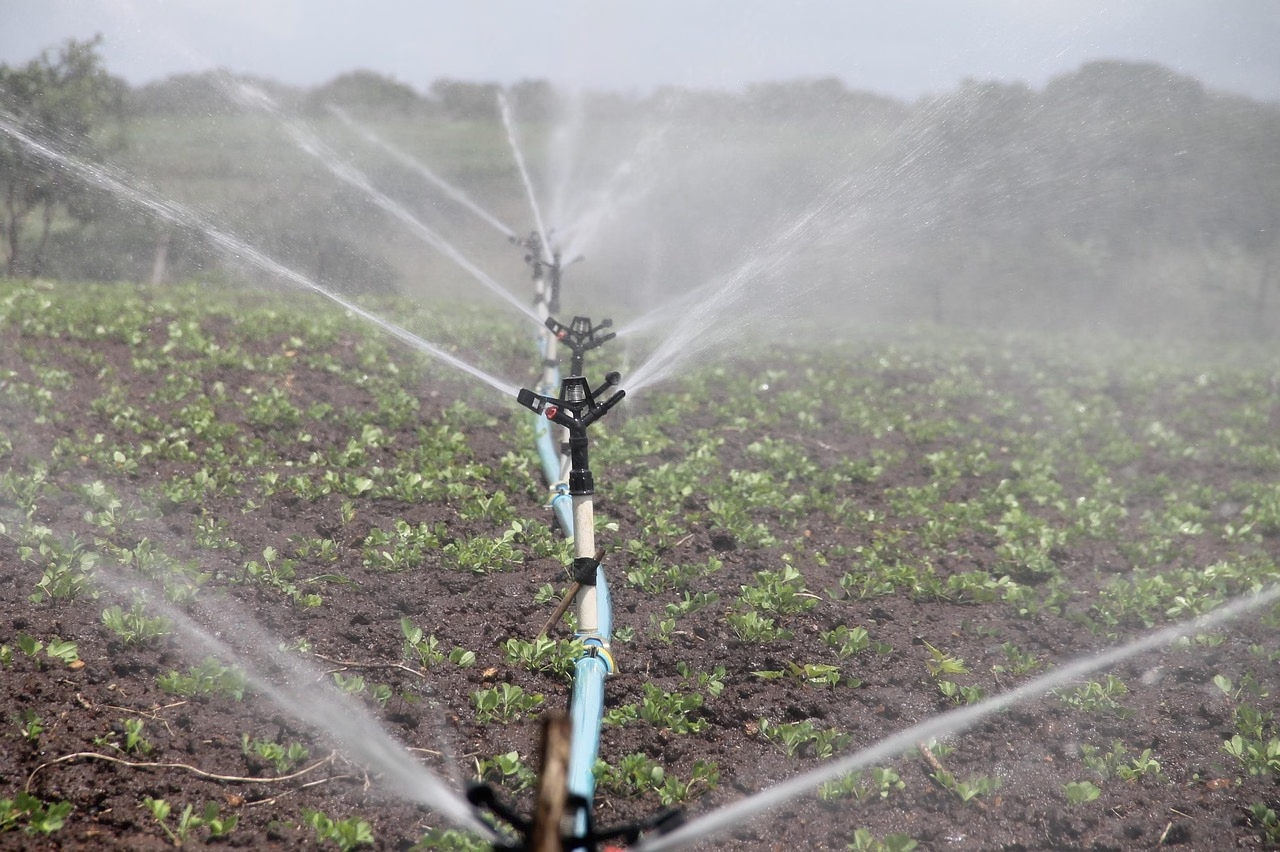
It is challenging to install the sprinkler system without knowing the pressure requirement and coverage information.
If you install without any prior experience or research, you’ll end up having a sprinkler system which does not fully cover the irrigation area.
The big question remains here: How Many Sprinkler Heads Can I Put on One Zone or Valve?
The exact number depends upon how much water your system can actually deliver and how much water each head uses.
In this guide, you will learn exactly how to work out the number of sprinkler heads per zone using simple math, a bucket, and a pressure gauge. Whether you are watering a small backyard lawn or laying out blocks of a larger farm or orchard, the same principles apply.
Are There Any Fixed Numbers?
The short answer is, “No,” there is not any exact fixed number for how many sprinkler heads for one zone.
Because a sprinkler zone is simply a group of heads controlled by one valve. All the heads on that valve run at the same time and share the same water supply. If you add too many heads, the water is divided into thinner and thinner streams, pressure drops, and every head performs worse than it should.
Think of it like a bank account. Your water supply is the balance, each head is a withdrawal, and a zone is a single transaction. If you try to withdraw more than you have, something fails.
However, I can throw you a rough number of different sprinkler heads, assuming a typical home water supply of roughly 10 to 15 gallons per minute (GPM).
- Pop-up spray heads: typically 4 to 8 per zone on a standard residential supply
- Rotor heads: typically 3 to 6 per zone
- Rotary nozzles (MP Rotators and similar): typically 6 to 12 per zone
- Drip emitters: dozens to hundreds per zone, because each uses a tiny flow
To precisely calculate how many sprinklers are needed for the zone, here are the simple steps you can follow.
Step 1: Find Out How Much Water You Have
The first step is to know how much water you have. Based on that, select the sprinkler head.
To know how much water you have, there are two numbers: first, flow (GPM) and pressure (PSI).
Measuring the Flow With the Bucket Test
The easiest and the home made solution to know the GPM is using the 5 Gallon Bucket.
- Turn off all water use in the house and on the property.
- Open the outdoor spigot closest to your water meter fully.
- Time how long it takes to fill a 5-gallon bucket.
- Calculate: GPM = 5 ÷ seconds × 60
For example, if the bucket fills in 30 seconds, your flow is 5 ÷ 30 × 60 = 10 GPM.
However, the bucket test understates the flow of water through the long garden hose or a small spigot to the sprinkler line.
Measuring the Flow With Water Meter
If you have the water meter with a sweep hand or flow indicator, you can read the flow directly.
- Shut off all water use.
- Open a spigot fully.
- Time how long the meter takes to register one cubic foot (about 7.48 gallons), or use the meter’s flow reading.
- Convert to gallons per minute.
Measuring the Pressure
Screw a simple pressure gauge onto the outdoor faucet. Measure tow value
- Static pressure: with no water running
- Working (dynamic) pressure: with water flowing at the rate you plan to use
Working pressure is the number that matters. A system with 60 PSI static pressure may only have 40 PSI left once water is moving through the pipes, valve, and fittings.
Farm and Well Water Supplies
If your water comes from the well, canal, tank, or pond, your flow is set by the pump rather than the municipal water supply. In that case, look for the pump curve and measure discharge with a flow meter.
Remember that pump flow changes with pressure. The pump curve is showing the relationship between flow and pressure. As you add more sprinklers, flow rises but pressure falls. Always use the flow figure at the pressure you actually plan to run, not the pump’s maximum.
Step 2: Apply a Safety Margin
Never design the zone to use 100% of your measured water flow.
The reason behind this is simple: municipal water fluctuates through the day, your neighbor uses the water at the same time you do, or someone turns on some heavy machinery that uses the most electricity.
A common rule of thumb is to design to about 75 to 80 percent of measured flow.
Usable Zone Flow = Measured Flow x 0.80
If your bucket test showed 10 GPM, your usable zone flow is 10 × 0.80 = 8 GPM.
Step 3: Know How Much Water Each Head Uses
Before installation, check for the range of the sprinkler head on the manufacturer performance chart to match the nozzle and pressure you plan to use.
Below is the reverse chart of typical values for common head types.
| Head Type | Typical Operating Pressure | Typical Flow Per Head | Typical Radius |
|---|---|---|---|
| Pop-up-Spray Head | 15 to 30 PSI | 1 to 4 GPM | 2.5 feet to 15 feet |
| Rotary nozzles | 20 to 55 PSI | 0.3 to 3 GPM | 8 to 35 feet |
| Residential rotor | 40 to 50 PSI | 0.5 to 5 GPM | 25 to 50 feet |
| Large impact or rotor | 40 to 75 PSI | 5 to 25 GPM | 40 to 90 feet |
| Drip emitter | 10 to 30 PSI | 0.5–4 GPH (0.008–0.07 GPM) | Local to the plant |
| Agriculture Rain Gun | 30 to 120 PSI | Between 15 to 120 GPM | 20 to 60 meeters |
Notice that a large nozzle spray head uses five times more water than the small quarter-circle nozzles. This is why counting heads alone does not work. You must count gallons per minute.
Also, a nozzle that covers a quarter circle uses roughly one quarter of the water of a full-circle nozzle of the same radius. A half-circle uses roughly half. Add up the real GPM of each head on the zone rather than assuming they all use the same amount.
Step 4: Use the Formula
The straight forward calculation is simple.
Heads per zone = Usable zone flow ÷ Flow per head
For example;
- Measured flow: 10 GPM
- Usable zone flow: 10 × 0.80 = 8 GPM
- Spray head flow (average): 1.5 GPM
8 ÷ 1.5 = 5.3 heads, so round down to 5 heads per zone
This example is if you have a common sprinkler head.
If you have mixed sprinkler heads, like two quarter-circle heads (0.5 GPM each), two half-circle heads (1.0 GPM each), and one full-circle head (2.0 GPM), this comfortably fits within a 10 GPM zone, so you could add more heads until the total approaches your usable flow.
If the math gives you 5.3 heads, use 5, not 6. It is better to have a slightly underloaded zone than to starve every head on it.
Never Mix the Different Head Type on One Zone
This is the one common mistake: different spray nozzles like pop-up sprays, rotors, rotary nozzles, and micro sprinklers apply the water at a different rate.
If you put a spray and rotors in the same zone and run them for the same amount of time, sprays will soak one area while the rotors barely wet the other. Keep each zone to one type of head, ideally with matched precipitation rates.
You should also separate zones by sun exposure, plant type, and slope. A shady flower bed and a sunny lawn do not need the same run time, so they should not share a valve.
Common Mistakes to Avoid
- Guessing instead of measuring. Many designs fail because the real flow was never measured.
- Ignoring working pressure. Static pressure alone is misleading.
- Designing to 100 percent of capacity. Always leave a margin.
- Mixing head types on a single zone. Precipitation rates will not match.
- Using a pipe that is too small. High velocity causes pressure loss and water hammer.
- Forgetting elevation changes. Hills and slopes change pressure significantly.
- Placing heads too far apart. Gaps in coverage cannot be fixed by running longer.
- Overloading an old system. Adding a few extra heads to an existing zone often ruins performance on every head.
Final Thougts…
Instead of asking, “How many sprinkler heads for a zone?” a better question is, “How many gallons per minute does my zone have, and how many gallons per minute does each head use?” Once you know those two numbers, the answer is simple division.
To get the precise numbers, use the calculations above so you’ll never have the headache of not fully covering the area or low- or high-pressure water spray.
If the numbers do not work, add another zone rather than overloading an existing one. It is the most dependable way to build an efficient, long-lasting irrigation system.
Leave a Reply