Fresh water sources are becoming scarcer as the need for fresh water is growing every year.
Now, there are ways to make fresh water from salt water; however, the process needs more resources, so it is not feasible on a small scale. Now, the other way is to use water-saving irrigation methods.
In those water-saving irrigation methods, deep irrigation is one transforming approach to delivering water precisely where it is needed most: directly to the root zone of plants, deep beneath the soil surface.
Whether you are a commercial farmer looking to maximize yield and minimize input costs, a landscape manager striving for sustainability, or an agricultural professional researching next-generation irrigation systems, this comprehensive guide will walk you through everything you need to know about deep irrigation: what it is, how it works, benefits, and the challenges.
What Is Deep Irrigation?
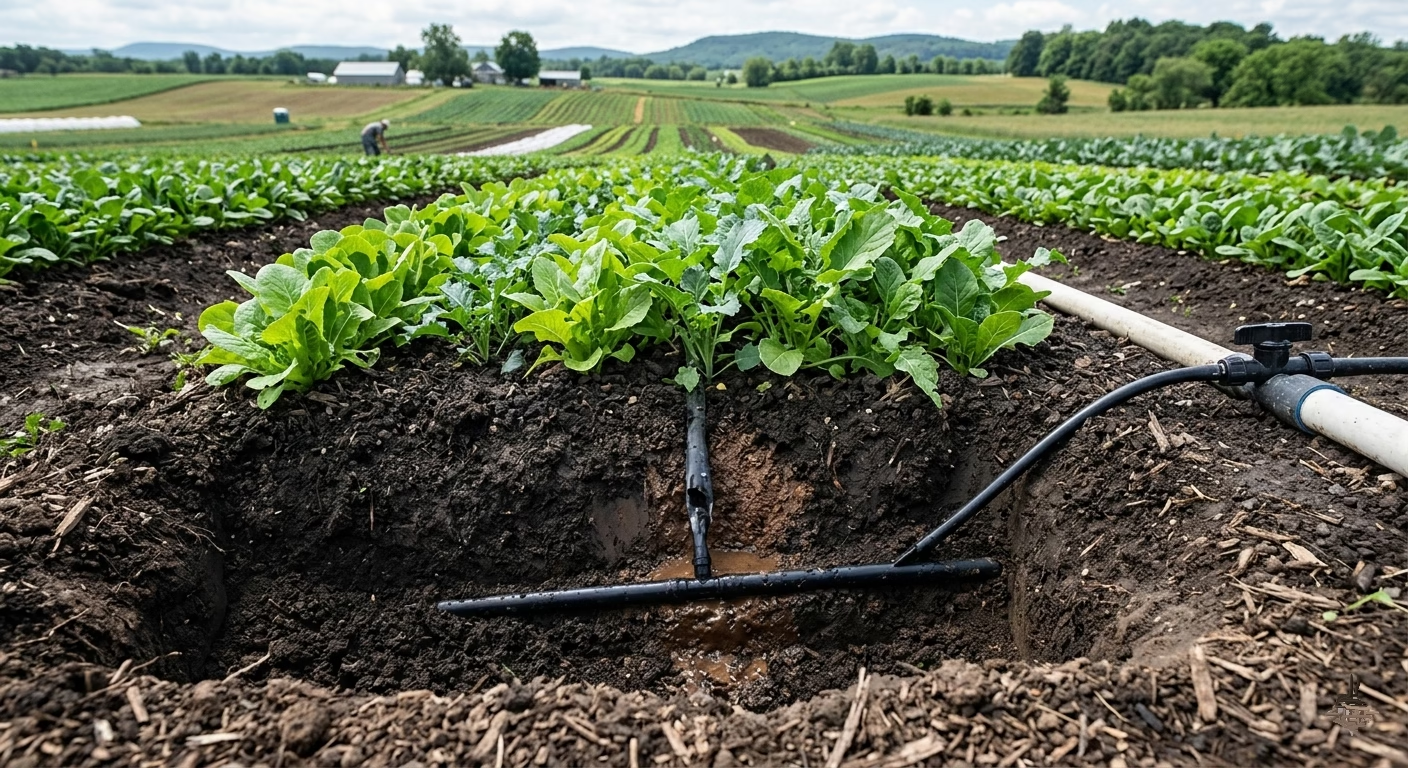
Deep irrigation is most commonly implemented as Subsurface Drip Irrigation (Deep Irrigation), where drip lines are buried deep into the soil surface, typically around 10 centimetres to 45 centimetres, depending upon the crop and soil type.
This advanced water delivery system delivers precise, small doses of water directly into the root zone, where plants can absorb it immediately.
Unlike traditional irrigation methods like flood, furrow, or sprinkler, where irrigation water is lost due to evaporation or wind drift, deep irrigation bypasses all external irrigation loss. The result is a system that can achieve water use efficiency rates of up to 95%, compared to just 60–85% for conventional approaches.
And don’t get confused with deep irrigation, drip irrigation, or deep root watering,all have many similarities but different traits.
Deep Irrigation vs Surface Drip Irrigation
The differences are crystal clear. Surface drip lines are laid on top of the soil, leaving them exposed to UV degradation, mechanical damage, and some degree of evaporation at the point of emission.
Deep irrigation buries those same lines, protecting them from the elements while directing water exclusively into the subsoil, where roots grow.
Deep Irrigation vs Deep Root Watering System
Here, the difference is slightly thinner because both deliver water deep underground, but in the deep root watering system, there are different types of methods used to deliver water deep into the ground.
However, in deep irrigation, surface drip lines are buried to deliver water underground.
When a drip lateral is buried at 30 cm, roots are encouraged to “chase” the water deeper into the ground. This leads to a stronger, healthier root structure that penetrates deep into the soil profile, as opposed to concentrating on the surface where moisture is inconsistent.
Key Components Used In the Deep Irrigation
Water Source & Pump Station
Water sources like wells, reservoirs, or municipal water supplies are used in most drip and deep irrigation systems, and to deliver water efficiently, high-pressure pumps are used.
Main & Sub-Main Line
Large-diameter PVC or polyethylene pipes carry water from the pump station across the field.
Filter System
Water delivered underground from buried emitters is difficult to access if any clogging occurs, so clean water is non-negotiable. Robust filtration systems remove sand, debris, algae, and other particulates that could clog the tiny emitter outlets.
Buried Drip Laterals
These are the core of the system,long lines or tapes installed beneath each crop row, equipped with emitters that release small, controlled volumes of water.
Emitters / Drippers
There are different types of emitters available in the market. Specifically, pressure-compensating emitters ensure uniform water distribution across uneven terrain, maintaining consistent flow rates regardless of slope variations.
Flush Valves & Air Release Valves
Critical maintenance features that keep the system clear of blockages and prevent air locks.
Fertigation Injector
Fertigation is optional but recommended. These allow soluble fertilizers and other inputs to be dissolved directly into the irrigation water and delivered to the root zone alongside moisture.
Biggest Benefits of Deep Irrigation
Deliver the Water Efficiently
Compared to traditional irrigation systems, where evaporation and water runoff are common, deep irrigation delivers water 95% efficiently.
To achieve the highest efficiency, you must design and maintain deep irrigation systems.
A well-maintained deep irrigation system keeps virtually all water within the root zone, increasing efficiency.
For context, agriculture accounts for roughly 47% of total freshwater withdrawals in the United States alone. Any significant improvement in irrigation efficiency translates directly into water security for farms, communities, and ecosystems.
Higher Crop Yield and Better Quality
When crops receive a precise amount of water and nutrition, they thrive.
Deep irrigation creates optimal growing conditions throughout every stage of plant development, from seedling to harvest, without the stress cycles of feast and famine that characterize traditional irrigation.
Crops grown using deep irrigation produce better yield while using a smaller amount of water. Studies on high-value crops like cantaloupe have found that subsurface irrigation can produce 10–28% higher marketable yields in early harvests compared to surface drip systems,a significant economic advantage.
Reduction In Weed
One of traditional irrigation’s main drawbacks is weed growth between crops, which leads to loss of water and nutrition.
In deep irrigation, weed growth is under control because the soil surface remains dry; the conditions that trigger weed seed germination are simply absent.
Suppression of Disease and Fungal Problem
When excessive moisture is present in the foliage, it promotes fungal growth, leading to many diseases.
Traditional irrigation penetrates the soil from above, making the soil wet and promoting fungal disease and mildew. Deep irrigation delivers water exclusively to the root zone, keeping leaves, stems, and fruit completely dry. This dramatically reduces the incidence of diseases that thrive on wet plant surfaces, lowering the need for fungicide applications and improving overall crop health.
Efficient Fertigation and Nutrition Delivery
Give fertilizers using the deep irrigation system because it delivers a precise amount of nutrition to the crop.
Fertilizers are dissolved into the irrigation water and directed straight to the root zone,the only place plants can actually absorb them.
This precision eliminates the nutrient leaching that plagues conventional systems, where over-application washes fertilizers beyond the root zone and into groundwater, an environmental and economic problem simultaneously solved.
Improved soil structure and Health
Without touching the soil surface, deep irrigation avoids crust formation and erosion of the topsoil.
The soil surface is never disturbed by water impact or pooling, preserving its structure and porosity. Deep root systems encouraged by subsurface moisture improve biological activity and organic matter levels in the soil over time, creating a positive cycle of improving fertility.
Ability to Farm During Irrigation
This is a main advantage of deep irrigation for commercial farms. During the irrigation event, the surface remains dry, allowing cultivation, spraying, and even harvesting.
This reduces the cost of processing, and timing every field activity around irrigation windows can create costly scheduling conflicts.
Long Term Durability and Lower Operating Cost
Buried drip lines mean they are protected from UV degradation, mechanical damage, frost exposure, and vandalism.
When high-quality materials are used and the system is properly maintained, it can operate for 20 years or more.
Operating pressures are also typically lower than those required for sprinkler systems, reducing energy costs substantially over the life of the installation.
Adaptability to any Field Shape or Terrain
Using components like pressure-compensating emitters, deep irrigation systems can effectively operate in irregular boundaries, rolling terrain, narrow strips, or large open paddocks.
This makes deep irrigation viable in landscapes where conventional systems would produce uneven coverage.
Environmental Responsibility
In deep irrigation, water wastage is minimal, which leads to minimal nutrient leaching and reduces water withdrawals from rivers and aquifers.
By being buried underground, deep irrigation protects local ecosystems, maintains natural water flow patterns in wetlands and waterways, and reduces agriculture’s contribution to greenhouse gas emissions from energy-intensive water pumping.
Challenges and Consideration in Deep Irrigation
Higher Initial Investment
Before burying the drip line, there should be upfront costs for planning and materials used in the system, which are higher than surface irrigation. This is a genuine barrier, particularly for smallholder farmers and operations in developing agricultural regions.
However, if you think long term, the cost picture changes significantly. Over a multi-year operational horizon, water savings, reduced fertilizer use, lower weed control costs, and higher yields combine to deliver a strong return on investment for most commercial applications.
Soil Compatibility
It is not possible to install deep irrigation without proper planning for every soil type. The system performs well in structured soil with good water conductivity.
However, clay-heavy soils with low infiltration rates require careful spacing of drip laterals to ensure adequate lateral water distribution. Sandy soils, conversely, drain quickly and may require higher-frequency irrigation schedules. Understanding your soil profile before system design is essential.
Maintenance and Clogging
Compared to surface drip irrigation, clogging in deep irrigation is harder to find and rectify.
The main causes of clogging are particulates in the water, biological growth, or root intrusion.
The solution is to use high-quality filtration at the water source, regular system flushing, and the use of anti-intrusion emitters and root-inhibiting treatments, essential maintenance disciplines for long-term deep irrigation performance.
Root Damage
Plant roots can penetrate drip emitters, causing serious damage to the irrigation system, and rodents can gnaw through buried drip lines.
These risks are manageable through careful system design, selection of thick-walled, high-quality drip lines, and preventative maintenance protocols, but they are real factors to plan for.
Technical Knowledge Requirement
To design an effective deep irrigation system requires knowledge about soil science, crop physiology, and system engineering.
Without proper knowledge, the system can be designed poorly and result in uneven water distribution, hot spots, and waterlogging.
Investing in professional system design is a non-negotiable prerequisite for success.
Still Confused to Install Deep Irrigation? Here Is The Decision Framework
Before investing in a deep irrigation system, ask yourself the following key questions:
What is the value of your crop?
High-value vegetables, fruit crops, and premium grain varieties generate returns that easily justify deep irrigation investment. Lower-value broadacre crops require careful economic analysis.
What is your soil type?
Sandy and loamy soils are excellent candidates. Heavy clay soils can work but require more careful design.
How scarce or expensive is water in your region?
In arid or semi-arid areas, and anywhere water pricing reflects true scarcity, the savings from deep irrigation efficiency gains can be transformative.
What is your current irrigation method?
Switching from flood irrigation offers the largest efficiency gains. Switching from surface drip offers meaningful but more modest improvements.
What is your operational scale?
Large commercial operations generate more financial benefit from Deep Irrigation than small hobby farms, though the technology scales down effectively.
Do you have access to technical support?
Good system design and ongoing maintenance expertise are essential. Identify qualified deep irrigation specialists in your region before committing.
Final Word…
Water scarcity is not a future problem anymore; it is now a concerning issue to address. As populations grow, climates shift, and freshwater resources come under greater pressure, the efficiency gains offered by deep irrigation are not merely desirable, they are essential.
For farmers willing to invest in the technology and commit to proper system design and management, deep irrigation delivers a remarkable combination of benefits: higher yields, lower input costs, reduced environmental impact, and greater resilience to drought. It is, in the most literal sense, a system that helps you grow more by doing more with less.
Leave a Reply